 COINNEWS
First AI Bubble Bursts
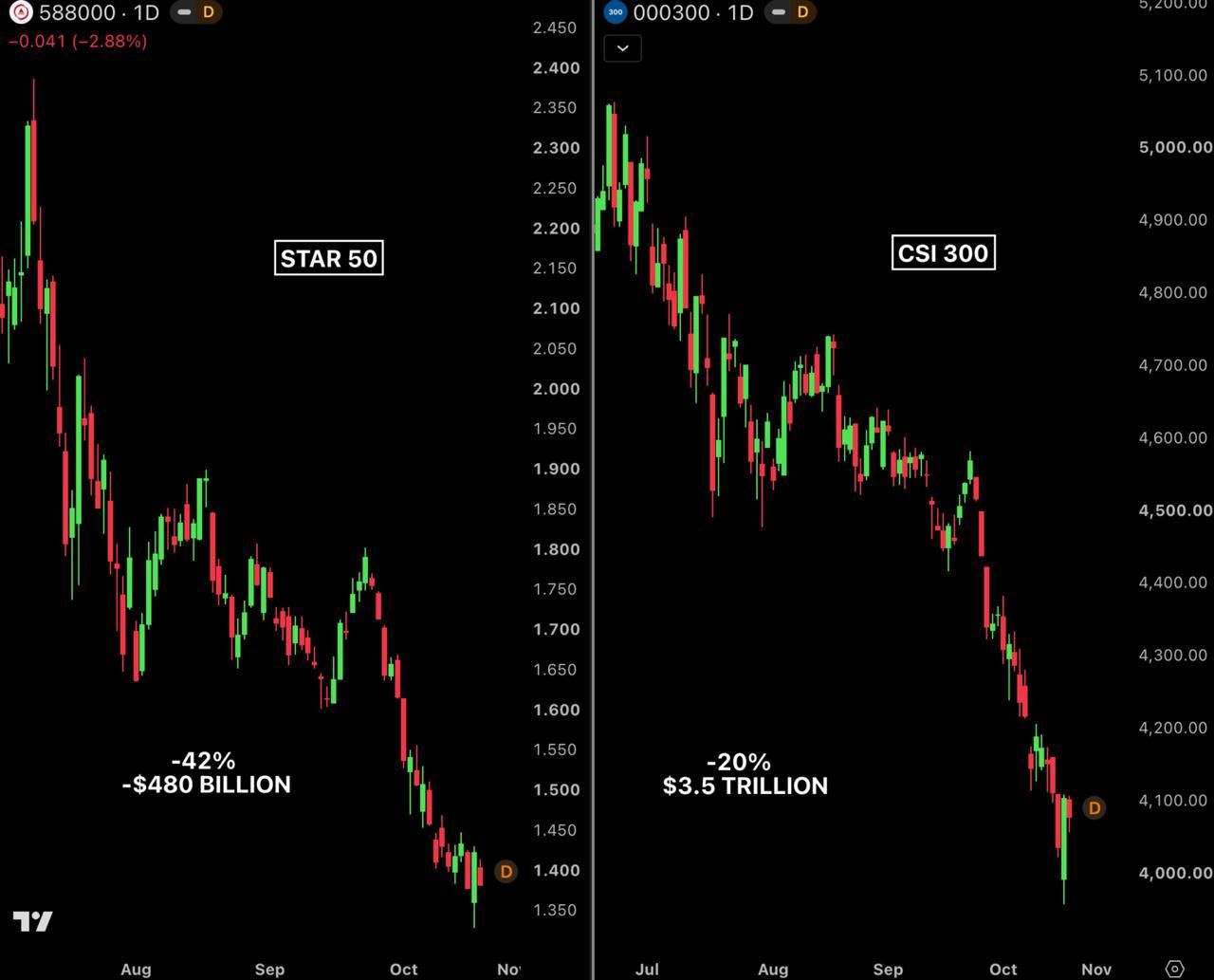
China's STAR50 index, which brings together the largest companies in artificial intelligence and chip manufacturing, plummeted by 40% in less than four months. The market capitalization of these companies shrank by approximately $480 billion.
The decline affected the entire market: the CSI300 index entered a bear phase, losing 20% from its June peak. Since May's high, Chinese stocks have collectively lost $3.5 trillion in value.
AI model developers MiniMax and Zhipu lost a combined $150 billion from their peaks. Unitree Robotics shares fell 50% since its August IPO, while optical component manufacturers Zhongji Innolight and Eoptolink dropped by about 60%.
Warning signs were evident in advance. At its peak, STAR50 traded at a multiple of around 250 annual profits. AI-linked companies accounted for 42% of China's market capitalization and 57% of trading volume, with growth driven mainly by retail investors.
A similar picture is emerging in the US. According to JPMorgan, AI companies represent 49% of the S&P 500 index's value, higher than China's 42% before the crash. The Shiller P/E ratio for the index exceeds 40.
This is the second-highest reading in over 150 years: it was only higher before the dot-com crash. Margin debt reached a record $1.5 trillion. Additionally, Anthropic filed an IPO application with a possible valuation of around $2 trillion despite losses of $80.7 billion in the first half of the year.
Analysts believe the US is showing the same signs that preceded the crash of AI stocks in China.