 Crypto Headlines
Bitcoin White Paper Turns 18: History and Facts
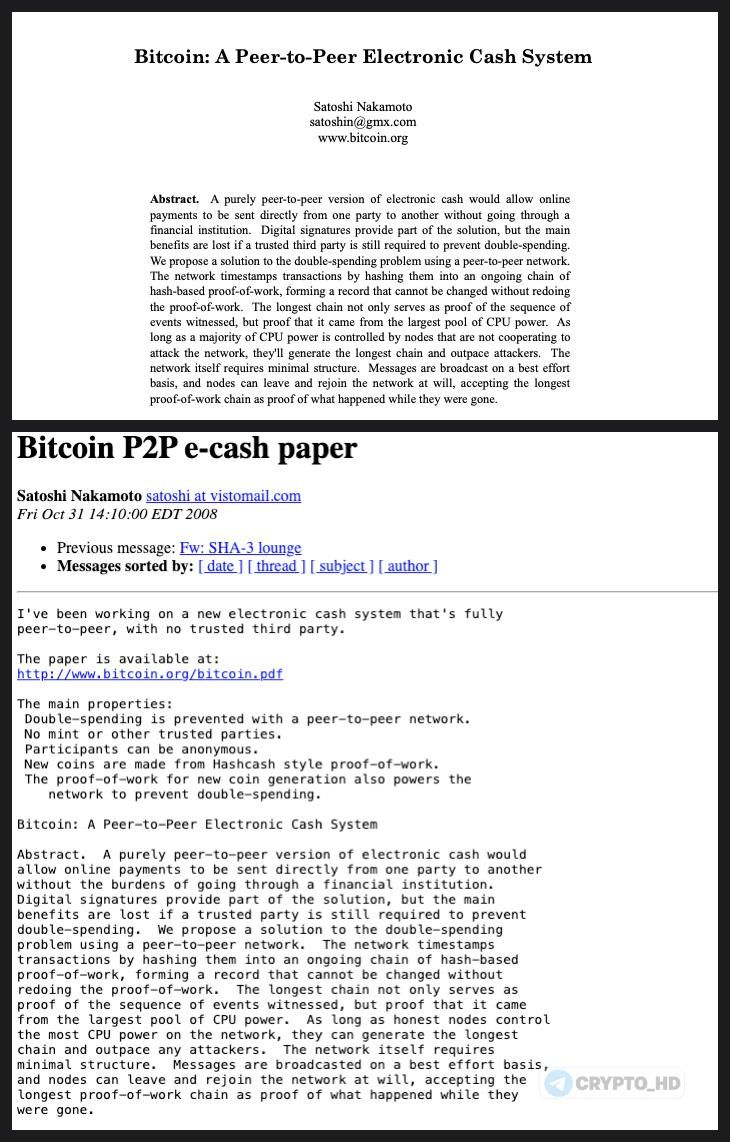
On October 31, 2008, amid the global financial crisis, Satoshi Nakamoto published the Bitcoin white paper: A Peer-to-Peer Electronic Cash System, laying the foundational concept of decentralized digital currency.
Key Goals of Bitcoin's Creation
The project's main idea was to eliminate financial intermediaries. The system enabled users to transfer funds directly to each other without banks or payment operators, ensuring direct transactions between network participants.
A key technical solution was protection against double-spending. Payments are verified by the distributed network itself, and the Proof-of-Work mechanism replaces traditional trust with cryptographic proofs, making it extremely costly to alter the transaction history.
Creating money without a central issuer ensured the currency's independence. New bitcoins are issued according to strict protocol rules, and miners receive rewards for securing and operating the network while maintaining participant privacy.
Historical Facts About Protocol Development
- The 21 million BTC limit was not mentioned in the original white paper but was hardcoded; Satoshi publicly announced this in January 2009.
- Development proceeded in reverse order: the software verifying the concept was written first, followed by the documentation.
- An earlier version of the document was titled Electronic Cash Without a Trusted Third Party, but its full text has never been found.
- Early bitcoins were mined on standard home computers running Windows due to low initial mining difficulty.
- The genesis block, created on January 3, 2009, included a headline from The Times about bank rescues.
Despite cryptographer James Donald's skepticism regarding the network's scalability, Satoshi predicted the emergence of specialized server farms. He also warned that the system was experimental and might require a restart if critical issues arose.