 Crypto Headlines
US White House Administration seeks to end the conflict between
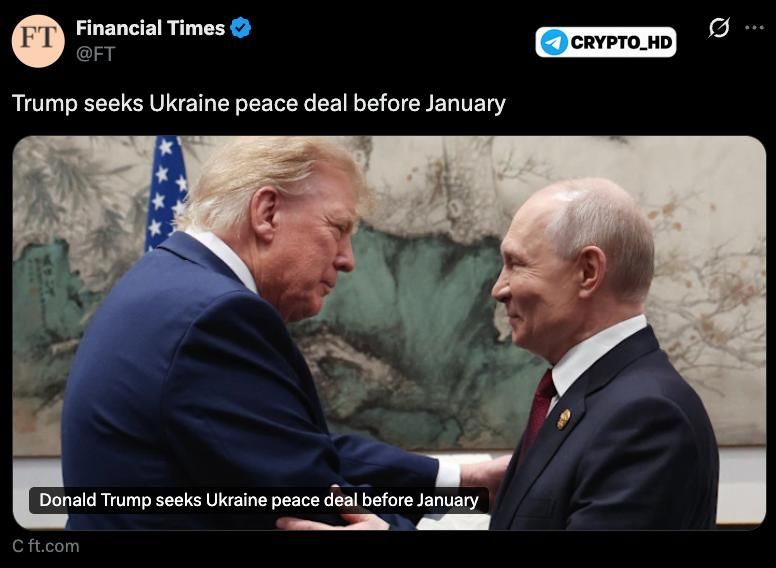
The US White House Administration aims to end the conflict between Russia and Ukraine by January 2027. This decision is linked to Republicans' desire to prevent increased sanctions pressure on Moscow after Democrats gain control of Congress.
Negotiations resume
Steve Witkoff and Jared Kushner have resumed negotiations with Moscow and Kyiv after an eight-month break. The parties are discussing security guarantees for Ukraine similar to NATO Article 5. However, Russia continues to demand the transfer of Donbas, Ukraine's refusal to join NATO, and restrictions on the size of the Ukrainian army.
Diverging positions
A quick peace deal remains unlikely due to significant disagreements on key terms. European officials express concern that Washington's rush could lead to excessive concessions to Russia. Donald Trump urged European leaders to reach a peace agreement with Russia, stating Putin's readiness to end the war.
European concerns
Diplomatic efforts continue
The US is actively trying to accelerate the peace process. The White House administration is considering concluding an agreement before a change in the political balance in Congress. Moscow has not yet shown willingness to hurry with signing the document.
Future of negotiations
Despite pressure from the US, the sides still differ on key issues. European partners are concerned about the possible consequences of hasty agreements. Diplomats continue to seek compromise solutions to stop military actions.
Negotiation outcomes
The current stage of negotiations is characterized by high tension. The US strives to achieve results as quickly as possible. Russia insists on its conditions. Europe awaits developments with caution.
Conclusion
A peace agreement between Russia and Ukraine is under active discussion. Key issues include territorial disputes and security. The political situation in the US affects the pace of diplomatic processes. The final decision depends on the consent of all parties to the conflict.
Key factors
Impact on the region
Events will significantly impact geopolitical stability. European countries are closely watching the US position. Possible concessions could change the balance of power in the region. The international community awaits negotiation results.
Prospects for peace
Chances of quickly achieving peace remain low. The sides maintain hardline positions. The diplomatic process requires time and mutual respect. Only a comprehensive solution to problems can lead to sustainable peace.
Role of international players
The US acts as the main mediator in negotiations. Russia and Ukraine have opposite views on the future. Europe tries to preserve its interests. International law plays an important role in resolving the conflict.
Economic aspects
Ending the war will open opportunities for economic recovery. Sanctions pressure affects both sides. The investment climate depends on political stability. A peace agreement could stimulate trade.
Humanitarian aspect
The conflict has led to serious humanitarian consequences. The civilian population suffers from combat operations. A ceasefire will allow aid to be provided to those affected. Infrastructure restoration will require significant resources.
Military context
Military actions continue on various fronts. Both sides are strengthening defensive capabilities. Strategic goals remain unchanged. A military solution to the conflict seems unlikely in the near future.
Diplomatic channels
Informal contacts remain an important tool for dialogue. Direct negotiations require preparation of conditions. Trust between the sides needs to be restored. International experience shows the importance of multi-level negotiations.
Political will
Country leaders must demonstrate political will. Compromise is necessary for success. Public opinion influences government positions. Long-term interests require a wise approach.
International law
Resolution should comply with international law norms. State sovereignty must be respected. Borders require clear definition. Legal mechanisms will help consolidate reached agreements.
Regional security
Stability in the region depends on ending the conflict. Alliances may be reviewed. Armed forces need reforming. Economic cooperation will become a priority after peace.
Conclusion
The peace settlement process is complex and multifaceted. All parties are interested in stopping violence. Diplomacy remains the main path to solving problems. The future depends on readiness for dialogue.
Key takeaways
Next steps
It is necessary to continue working on agreement details. Technical issues require detailed elaboration. Control mechanisms must be effective. Trust is restored gradually.
Role of media
The information space influences public opinion. Objective coverage is important for understanding the situation. Rumors can destabilize the process. Facts help make balanced decisions.
Public opinion
Citizens of both countries want peace. War weariness is growing. Leader support depends on negotiation results. Society is ready for changes given security guarantees.
Economic sanctions
Sanctions are putting pressure on the Russian economy. Their removal is part of the negotiation process. The impact of sanctions on global markets is noticeable. The economy needs stabilization.
Infrastructure restoration
Destroyed facilities require immediate repair. Restoration funding will be large-scale. International assistance is needed. Construction will create jobs.
Refugee problem
Millions of people have left their homes. Refugee return depends on security. Social adaptation requires support. States must help returnees.
Energy security
The energy sector suffered from the conflict. Gas supply negotiations are ongoing. Europe's dependence on Russian energy resources is decreasing. Diversification of energy sources continues.
Food security
Ukraine is a major grain exporter. Port blockades affected world prices. Restoring logistics is critically important. The food crisis requires attention.
Cybersecurity
Cyberattacks have become part of hybrid warfare. Protecting critical infrastructure is mandatory. International cooperation in this area is important. Technologies are developing rapidly.
Information war
Propaganda is used by both sides. Fighting fake news is necessary. Media literacy of the population is increasing. Truth must prevail in the information space.
Cultural exchange
Cultural ties were severed. Dialogue restoration is possible after peace. Art unites peoples. Education promotes mutual understanding.
Scientific cooperation
Science should not suffer from politics. Joint research is beneficial for everyone. Academic exchanges are being restored. Innovation requires open borders.
Tourism
The tourism industry is halted. Tourist safety is a priority. Tourism development will bring revenue. Visa regimes may ease.
Transport infrastructure
Roads and bridges are destroyed. Restoration will take years. Logistics chains are disrupted. Transport communication will be restored gradually.
Environmental problems
Military actions have damaged the ecology. Environmental pollution requires cleanup. Natural resources are depleted. Ecological safety is important.
Public health
The medical system is overloaded. Psychological help is needed by many. Access to medicines is limited. Citizens' health must be protected.
Education
Schools and universities are damaged. Children's education continues online. Education quality must be maintained. Youth needs prospects.
Social protection
Pensioners and disabled people are suffering. Social payments are delayed. Help for those in need is necessary. The state must support vulnerable groups.
Jobs
Production has stopped. Unemployment is rising. Retraining of personnel is required. Economic revival will create jobs.
Small business
Entrepreneurs have lost clients. Loans are hard to obtain. Support for small business is important. The business environment should improve.
Financial system
The banking sector is unstable. Exchange rates fluctuate. Inflation is rising. Financial stability is necessary for growth.
Investments