 Backdoor
The Largest Crypto Heist in History
The Largest Crypto Heist in History
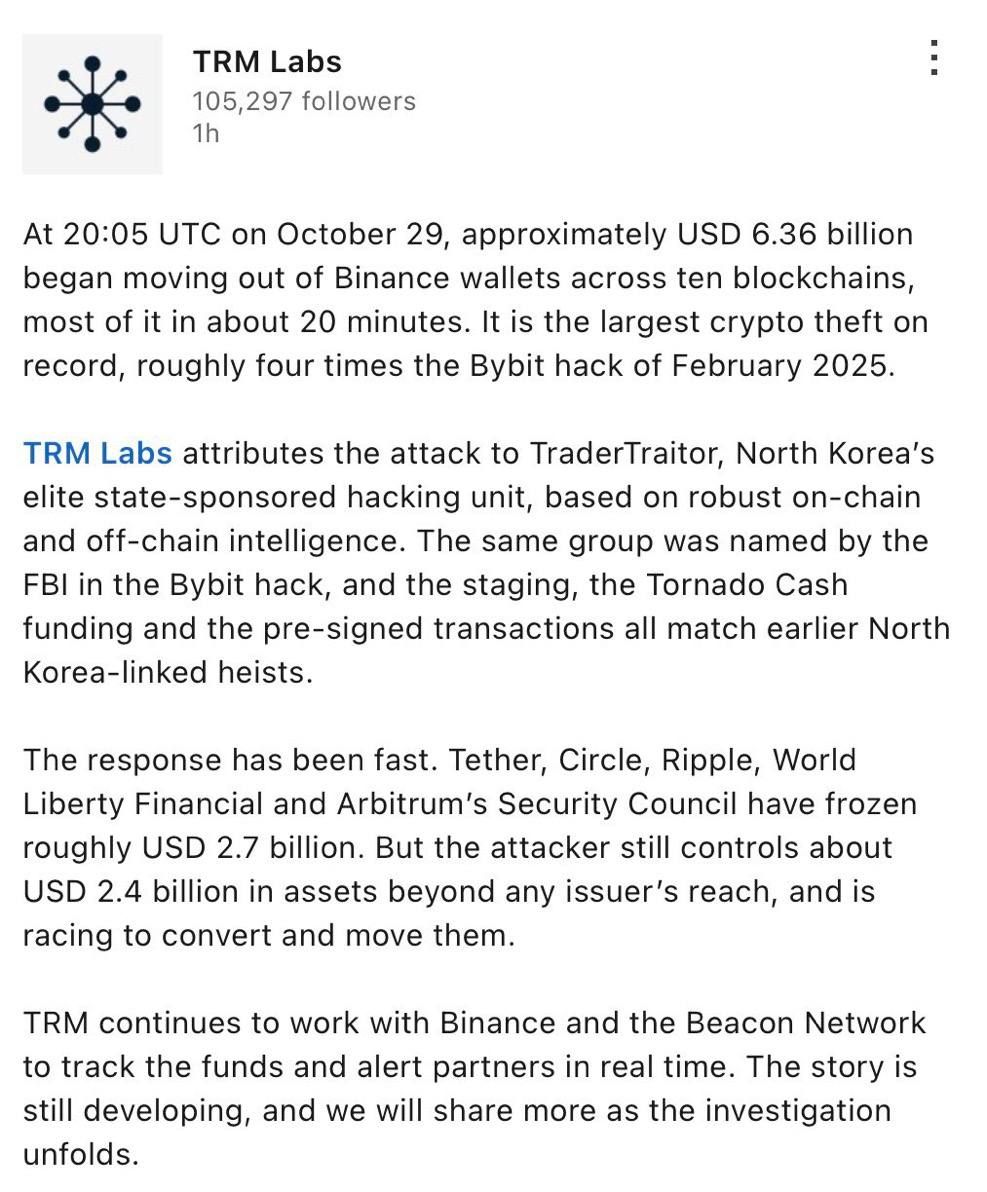
North Korea Carries Out Massive Binance Hack, Stealing Approximately $6.3 Billion. This is the largest operation of its kind in the history of the cryptocurrency market. The attack was carried out by the TraderTraitor subgroup, part of the Pyongyang-sponsored hacker group Lazarus.
Scale of Damage and Speed of Attack
The hack occurred within just 20 minutes. Hackers withdrew stolen funds through 10 different blockchain networks. In total, between 2024 and 2025, the attackers stole $2.7 billion, which represents about 10% of North Korea's GDP. A similar attack was carried out on the Bybit exchange in 2025.
The Role of the Lazarus Group in Cybercrime
TRM Labs analysts have confirmed the link between the attacks and North Korean intelligence. The Lazarus group uses cryptocurrencies to fund state programs. The stolen assets allow Kim Jong Un to support the country's economy using external resources.
Security Issues with Crypto Exchanges
The incident exposed vulnerabilities in major centralized platforms against coordinated state-sponsored attacks. Despite attempts to block transactions, a significant portion of the funds remains inaccessible. The industry faces the need to strengthen protection measures against highly skilled hackers.
Financial Consequences for Affected Parties
Binance and user losses amount to a colossal sum. Frozen assets may be returned after investigation; however, $2.4 billion is lost forever. This highlights the risks of storing large volumes of funds on a single platform.
State Sponsor of Cyberattacks
The technical complexity of operations requires significant resources. North Korea uses these funds to circumvent international sanctions. Attacks on Bybit and Binance demonstrate the group's ability to act quickly and effectively, utilizing multiple blockchains for anonymization.
The Future of Crypto Security
The Binance incident will be a turning point for the industry. Regulators and exchanges are forced to review security protocols. Combating organized cybercrime requires international cooperation and new transaction tracking technologies.
Summary of TRM Labs Investigation
Experts continue to analyze fund movement routes. Identifying links between TraderTraitor and Lazarus helps better understand the adversary's tactics. Blockchain transparency allows partial tracking of activity but does not guarantee asset recovery.
Significance of the Event for the Market
Investor confidence in centralized exchanges may decline. Market participants expect stricter requirements for fund storage. The incident shows that even industry giants are not immune to targeted state-sponsored attacks.
Prospects for Countering Lazarus
The international community is attempting to counter the group's activities. Sanctions and technological restrictions do not fully stop the hackers. New approaches to protecting the digital infrastructure of financial institutions are needed.
Lessons for Market Participants
Diversification of asset storage has become critically important. Using cold wallets and multisignature addresses can reduce risks. Awareness of the working methods of groups like Lazarus helps make safer decisions.
Conclusion on the Incident
The Binance hack reflects an escalation in cyber conflicts. State actors actively use cryptocurrencies to achieve political goals. The industry must adapt to new threats to protect user capital.
Long-term Consequences
Regulatory pressure on crypto exchanges will intensify. Implementing stricter KYC and AML procedures will become the standard. Data and user fund security will take center stage when choosing a trading platform.
The Role of Analytics Companies
Companies like TRM Labs play a key role in uncovering schemes. Their data helps law enforcement agencies and exchanges respond faster. Developing blockchain analytics tools is essential to combat organized criminal networks.
Evolution of Attack Methods
Hackers are moving from simple thefts to complex multi-stage operations. The use of multiple networks complicates tracking. The speed of attacks, as seen in the Binance case, requires immediate response from security services.
Loss Statistics
The total damage from TraderTraitor's actions is enormous. The ratio of frozen to lost funds shows the effectiveness of protection and system vulnerability. Figures of $2.7 billion and $2.4 billion are becoming new records for losses.
Impact on the DPRK Economy
Cryptocurrency theft directly affects the country's budget. The 10% share of GDP constitutes substantial state support. This creates a vicious cycle of regime dependence on cybercrime.
Exchange Countermeasures
Binance and other platforms are implementing new protocols. Strengthening monitoring of suspicious transactions in real-time. Collaboration with analytics firms is becoming a mandatory element of security strategy.
Future of Regulation
Governments will demand greater transparency. Crypto exchanges will face strict reserve storage requirements. Incidents of this scale accelerate the adoption of legislative acts in the digital asset sector.
Technical Aspects of the Hack
Withdrawing funds through 10 networks was a calculated step. This hindered the rapid blocking of all outflow paths. Experts are studying the technical details of the attack to prevent similar incidents in the future.
The Role of the Community
Information openness helps realize the scale of the problem. Data sharing among market participants increases overall security. The crypto enthusiast community plays an important role in supporting transparency.
Expert Forecasts
An increase in targeted attacks on major exchanges is expected. State-sponsored hacker groups will continue to use cryptocurrencies. The industry must develop at a faster pace in the field of protection.
Historical Context
The Binance attack fits into Lazarus's long-term strategy. Previous successes, such as the Bybit hack, show a systematic approach. Cryptocurrency history now includes this episode as one of the most significant.
Protection of User Assets
Users are advised to diversify portfolios. Do not store all funds on a single exchange. Using hardware wallets reduces the risk of losing funds if a centralized platform is compromised.
The Role of Law Enforcement
International cooperation is necessary to curb Lazarus's activities. Arrests and asset confiscation are possible with sufficient evidence. TRM Labs' work provides important evidence for courts.
Development of Blockchain Analytics
Transaction tracking technologies are becoming more sophisticated. Machine learning algorithms help identify fraud patterns. Investments in blockchain security are growing proportionally to increasing risks.
Ethical Questions
Using stolen funds to finance a state raises controversy. International law currently lacks clear mechanisms for regulating cyberattacks by countries. This precedent could change legal norms.
Impact on Cryptocurrency Prices
Major leaks can put pressure on the market. Fear of losing funds leads to sell-offs. However, in the long term, this stimulates the development of more reliable solutions.
Binance's Strategy
The exchange will take steps to restore its reputation. Compensating users for losses may become part of the plan. Improving security infrastructure will be a priority for the coming years.
Lazarus Prospects
The group has no intention of stopping its activities. Successful attack experience motivates them to carry out new operations. Countering them requires global efforts and information exchange between countries.
New Security Standards
The crypto industry will begin to implement industry-wide security standards. Joint efforts by exchanges and developers will create a more resilient ecosystem. The risk of similar incidents recurring will be reduced.
The Role of Media
Covering events raises public awareness. Reliable information helps avoid panic. Analyzing facts, rather than speculation, contributes to the healthy development of the market.
The Future of Cyber Warfare
Cyberspace is becoming a battlefield for states. Cryptocurrencies are a new weapon in this war. Protecting the digital economy requires constant technological improvement.
Expert Conclusions
Experts agree on the need for radical changes. Current protection methods are insufficient against state actors. A new level of cooperation and technological progress is required.
Final Summary
The Binance hack became a turning point. It demonstrated the vulnerability of centralized systems. The future of cryptocurrencies depends on the industry's ability to adapt to new threats and ensure fund security.
Recommendations for Traders
Do not blindly trust all exchanges. Study the reputation of platforms. Use additional levels of account protection. Be prepared for potential service disruptions.
The Role of Innovation
Decentralized Finance (DeFi) may offer an alternative. Self-custody gives greater control over assets. However, DeFi is also subject to risks requiring attention.
Conclusion