 COINNEWS
Robert Kiyosaki's Forecast on the Upcoming Economic Crisis
Robert Kiyosaki's Forecast on the Upcoming Economic Crisis
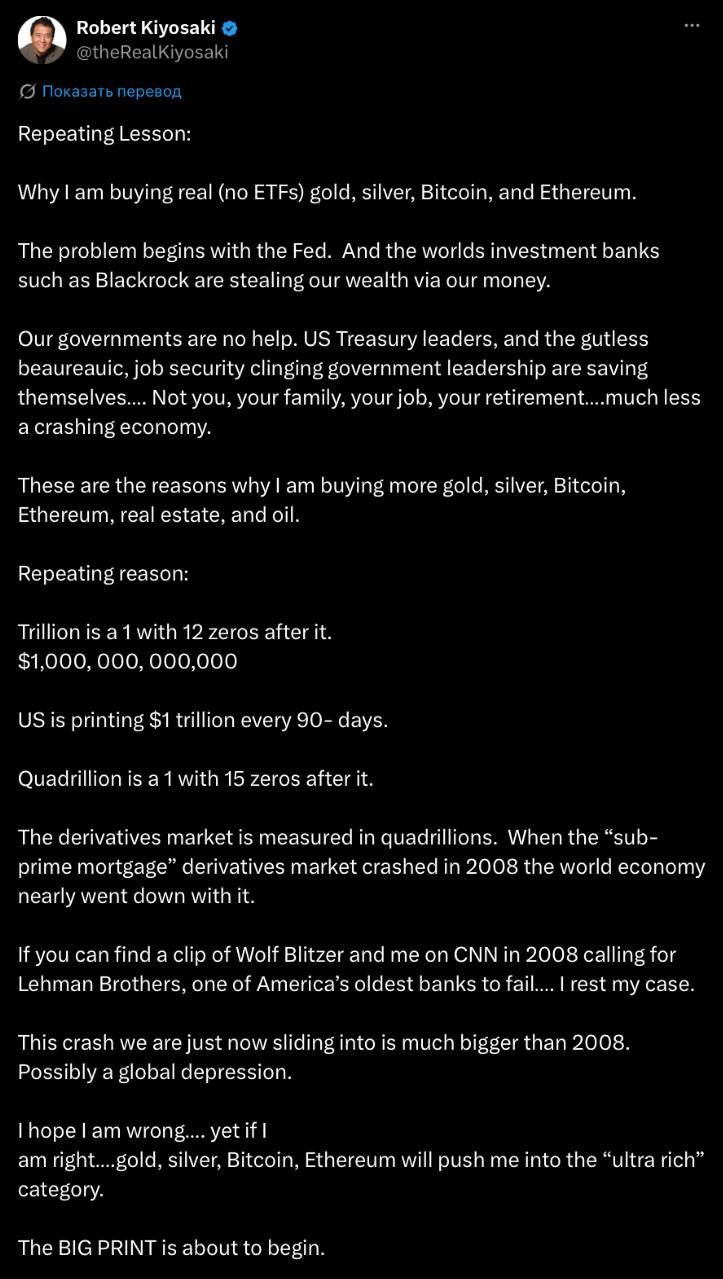
The author of the bestseller 'Rich Dad, Poor Dad', Robert Kiyosaki, warns that the global economy is only at the beginning of a major downturn. In the worst-case scenario, the situation could lead to a global depression that would be far more devastating than the 2008 crisis.
Derivatives Risk and Macroeconomic Factors
The expert identifies the derivatives market, valued in quadrillions of dollars, as the primary source of danger. It was the collapse of mortgage financial instruments in 2008 that brought the world's financial system to the brink of catastrophe. The situation could be exacerbated by a new wave of money printing, the rapid growth of US government debt, and mass job losses amid the development of artificial intelligence.
Investor Capital Protection Strategy
As protection against potential turmoil, Robert Kiyosaki continues to bet on assets with historical resilience. The investor recommends diversifying the portfolio by including gold, silver, Bitcoin, Ethereum, real estate, and oil.
Kiyosaki admits he would like to be wrong in his forecasts. However, if his scenario comes to pass, he expects not only to preserve his capital but also to significantly increase his wealth.
Analysis of Risks in the Derivatives Market
The size of the derivatives market amounts to quadrillions of dollars, creating systemic risks for the global economy. Historical experience from 2008 shows the financial system's vulnerability to the fall of complex financial instruments. Modern factors, such as the rise in US government debt and the impact of AI on employment, add uncertainty.
Diversification as Key to Survival
The proposed strategy includes a wide range of assets: from classic metals to cryptocurrencies and real sectors. This reduces dependence on a single income source and protects against inflation and the devaluation of fiat currencies. The success of the strategy depends on the investor's ability to adapt to changing market conditions.
Growth Prospects Under a Negative Scenario
Despite the pessimistic forecast, Kiyosaki sees opportunities for wealth growth in times of crisis. Proper allocation between defensive and growing assets can ensure significant profits. Readiness for various scenarios is an important skill for modern investors.
Conclusion on the Expert's Forecast
Robert Kiyosaki's forecasts attract investors' attention due to their caution and emphasis on fundamental values. Following his recommendations requires discipline and long-term planning. The derivatives market and macroeconomic indicators remain key indicators for assessing risks.
The Role of Gold and Bitcoin in the Portfolio
Gold and silver traditionally serve as insurance against economic instability. Bitcoin and Ethereum are added to the portfolio as high-yield but volatile assets. Oil and real estate provide stability and protection against inflation. This approach allows balancing risk and return.
Impact of Artificial Intelligence on the Economy
The development of artificial intelligence leads to mass job losses, affecting consumer demand. This factor can exacerbate the consequences of an economic downturn. Investors need to consider social changes when forming strategies. Adapting to new realities has become an essential task.
US Government Debt as a Crisis Trigger
The rapid growth of US government debt creates pressure on the dollar and financial markets. A new wave of money printing could lead to inflation. These factors reduce the attractiveness of traditional bonds and stocks. Protecting capital through alternative assets becomes a priority.
Capital Preservation Strategy in a Crisis
The main goal of the strategy is to preserve the purchasing power of funds in uncertain conditions. Diversification across asset classes reduces overall portfolio risk. Flexibility in investment management allows responding to market changes. A long-term planning horizon helps weather short-term fluctuations.
Investor Expectations for the Future
Robert Kiyosaki hopes for a positive outcome but prepares for the worst. His confidence in his own assets is based on years of experience. Implementation of a pessimistic scenario could become an opportunity for financial growth. The importance of choosing the right assets is emphasized in every forecast.
Final Analysis of Risks and Opportunities
The economic landscape remains complex due to many interrelated factors. The derivatives market, government debt, and technological changes require careful monitoring. Kiyosaki's strategy offers concrete steps for protecting investments. Following these principles can help investors avoid losses.
Risk Management Recommendations
Investors should review their portfolios in light of new forecasts. Assessing risks in the derivatives market should be constant. Diversification between gold, cryptocurrencies, and real estate is recommended as a basic measure. Readiness for change is the key to success in financial markets.
Protection Against Global Depression
A global depression poses a serious threat to the world economy. Preventing losses requires a proactive approach to investments. Assets mentioned by Kiyosaki have growth potential in crisis conditions. It is important to act in advance rather than react to events that have already occurred.
Prospects for Bitcoin and Ethereum
Digital assets are viewed as part of an inflation protection strategy. Their volatility is compensated by the potential for high returns. Integration into a traditional portfolio requires understanding the specifics of the market. Long-term holding can yield significant results.
The Role of Real Estate in Capital Protection
Real estate provides a steady income stream and protection against currency devaluation. During crises, housing demand may remain resilient. Property management requires knowledge and experience. Investments in this sector complement other assets in the portfolio.
Oil as a Commodity Asset
Oil is an important element of the global economy and investment strategies. Oil prices depend on geopolitics and demand. Including oil in a portfolio helps hedge risks. Analyzing market trends is necessary for decision-making.
Gold and Silver: Timeless Values
Precious metals have maintained their value for centuries. They are a reliable store of wealth during periods of instability. Investing in physical metals or ETFs allows participation in their growth. Balance in the portfolio is important for minimizing risks.
Impact of Money Printing on the Economy
A new wave of money printing can lead to inflation and a decline in currency exchange rates. Central banks use this tool to stimulate the economy. However, excessive printing carries risks for savings. Investors must consider these factors when choosing assets.
Growth of US Government Debt and Its Consequences
High levels of US government debt limit the government's ability to support the economy. This could lead to higher interest rates and a weaker dollar. Investors respond to these signals by reallocating assets. Monitoring fiscal policy is important for forecasting.
Technological Changes and Employment
AI development is transforming the labor market, creating new professions and destroying old ones. Mass job losses reduce consumer activity. This affects corporate profits and stock markets. Adapting to technological shifts is necessary for investors.
Comparison with the 2008 Crisis
The current situation has similarities with the pre-crisis period of 2008. However, the scale of the derivatives market has grown significantly. This increases the potential damage from a systemic failure. Studying past experiences helps prepare for future challenges.
Investor Psychology in a Crisis
Emotional stability is crucial for successful capital management. Panic often leads to unprofitable decisions. An action plan based on facts helps maintain composure. Trust in the chosen strategy strengthens the investor's position.
Long-Term Investment Planning
Short-term market fluctuations should not dictate strategy. A long-term approach allows leveraging the benefits of compound interest. Diversification reduces portfolio volatility. Regular rebalancing maintains target asset proportions.
The Role of Education in Investing
Financial literacy helps make informed decisions. Studying economic cycles raises awareness. Analyzing expert opinions, such as those of Kiyosaki, broadens horizons. Continuous learning is the key to success in financial markets.
Global Economic Trends
The world economy faces numerous challenges. Geopolitical tension and trade wars affect markets. Investors must follow global trends. Global diversification can reduce risks.
Protection Against Inflation
Inflation erodes the value of money. Fixed-income assets lose their appeal. Real assets, such as real estate and commodities, protect against inflation. Cryptocurrencies are also considered as hedges.
Liquidity Management
Having liquid funds is important for seizing opportunities in the market. Access to cash may be limited during crises. A balance between investments and cash holdings is necessary. A reserve fund ensures financial security.
Choosing a Broker and Platform
Broker reliability is critically important for an investor. Low commissions and a user-friendly interface facilitate trading. Access to broad markets allows portfolio diversification. Checking licenses and reputation is mandatory.
Taxes and Investments
Tax planning can significantly impact final returns. Different jurisdictions offer different tax regimes. Consulting with a tax specialist is recommended. Tax optimization increases the investor's net profit.
Ethical Investments
ESG criteria are becoming increasingly popular among investors. Corporate social responsibility affects reputation and stock price. Ethical considerations may align with financial gain. Business transparency is important for long-term investments.