 Backdoor
How to Choose a Claude Model to Optimize Costs
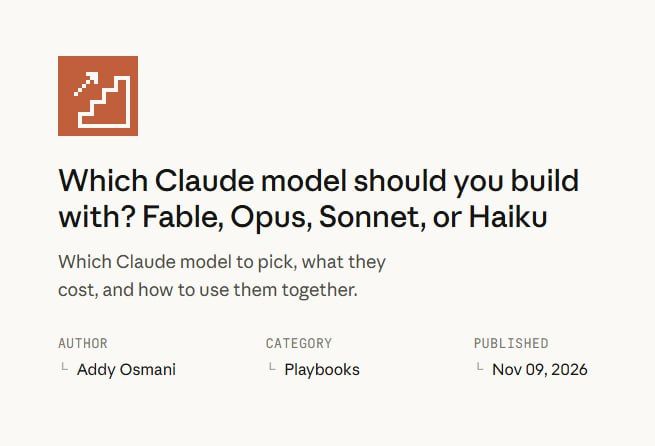
Anthropic published a guide on selecting Claude models to optimize costs and development efficiency.
The choice of model depends on task complexity. Opus 5.5 is recommended as a universal option for most medium-level workflows.
Sonnet 5.5 is suitable for routine tasks, communication, and documentation writing with a polished pipeline. Haiku 5.5 is the fastest and cheapest model, ideal for sub-agents.
Fable 5.2 is designed for complex research, planning, and project management. It is important to consider changes in the operation of the built-in Explore agent.
Previously, the Explore agent ran on the lightweight Haiku model, but now it uses the session's primary model. This can lead to non-targeted consumption of Fable 5.2 limits.
To automatically configure Claude Code, you can use a special prompt that optimizes the use of sub-agents.
The prompt includes version checks, alias configuration, and creation of specialized agents: Explore for search, log-reader for log analysis, and test-runner for tests.
Agents are created without file editing permissions, which enhances security. It is recommended to use haiku for resource-intensive operations and reserve main models for decision-making.
Instructions for distributing tasks between models and sub-agents should be added to the CLAUDE.md file.
- Delegate search, long logs, and tests to sub-agents, while handling simple tasks independently.
- Verify sub-agent outputs before making any edits.
- In case of errors, first verify yourself with tests, then increase the effort level.
An optimal strategy involves adjusting the effort level before switching models. Opus 5.5 remains the base recommendation, Sonnet 5.5 for documents, and Fable 5.2 for architecture.