 Not a Bug, but a Feature
Why Using AI Increases Employees' Working Hours
A study by ActivTrak revealed a paradoxical relationship between the implementation of artificial intelligence and working hours. An analysis of data from 450 organizations involving more than 9,100 employees showed that active use of neural networks increases time spent at the workplace.
The AI Paradox: More Time Spent Working
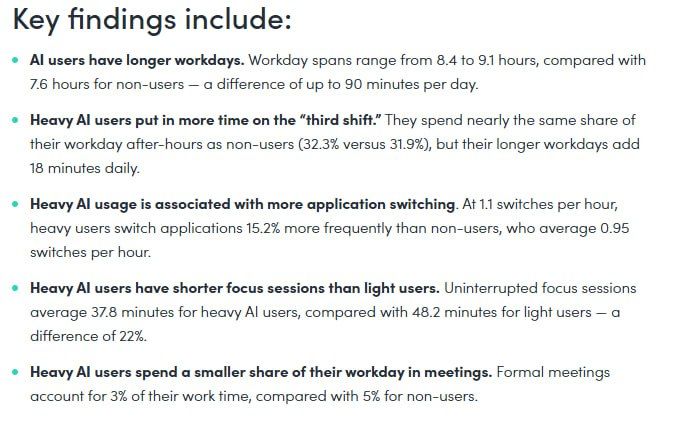
Employees who rarely use artificial intelligence tools spend about 8 hours in the office each day. Meanwhile, active users of neural networks stay at work for 8.4 to 9.1 hours. The difference amounts to more than one hour of work time daily.
Researchers explain this phenomenon through several factors. First, AI does not always reduce overall workload; sometimes it even increases it due to new tasks.
Main reasons for increased working hours:
- Employees take on additional responsibilities that were previously performed manually or were not required.
- Frequent switching between tasks reduces overall efficiency and stretches the process over time.
- A significant portion of the workday is spent checking and verifying results generated by artificial intelligence.
There is also an alternative viewpoint: companies actively implementing AI technologies typically already have a high volume of work tasks. Implementing automation may be a reaction to this overload rather than its cause.